
"This has been powered by a rebound in the agricultural sector following the drought in 2009-10, and a sharp pick-up in private consumption and gross fixed capital formation," CMIE said.

The state's economic health is in focus as it has consistently breached the fiscal deficit in eight of the last 10 years since Telangana's formation.

For one, growth was not primed by government cash transfers like salary hikes and NREGA payments alone. Gross fixed capital formation (investment in lay terms) picked up sharply in this period compared to the previous quarter.
India can sustain 8 per cent annual GDP growth and the conducive macroeconomic configuration may become a launching pad for a step-up in the country's growth trajectory, said an article on the 'State of Economy' in the central bank's March Bulletin published on Tuesday. Over the period 2021-24, gross domestic product (GDP) growth has averaged above 8 per cent. The global economy is losing steam, with growth slowing in some of the most resilient economies and high frequency indicators, pointing to further levelling in the period ahead, said the article authored by a team led by RBI Deputy Governor Michael Debabrata Patra.

India has allocated Rs 1.72 trillion, or 27.67 per cent of the total defence budget to cater to modernisation of the country's arsenal. Modern militaries spend up to 50 to 60 per cent of their total defence budget so that they go into combat with superior weaponry and equipment.

As a percentage of the aggregate Budget expenditure, it is 12 per cent.
It is 10 years since Bandhan Financial Services became the first microfinance institution (MFI) to receive the universal bank licence. A year later, in 2015, it started operations. Bandhan's entry into banking was seen as a vote of confidence by the Reserve Bank of India (RBI) for the country's microfinance sector. Subsequently, the RBI awarded small finance bank licences to nine MFIs.

The consistently heavy downpour of films, shows, events, videos and whatnot is causing economic disruption.

This is mainly due to GST impact on manufacturing and subdued farm output.

A series of steps taken by the government to promote ease of doing business and liberalisation of foreign direct investment norms have helped India receive record FDI inflows so far this year, and implementation of measures like PM Gati Shakti, single window clearance and GIS-mapped land bank are expected to further push investments in 2022. Notwithstanding the global slowdown and the COVID-19 pandemic, total foreign direct investments into India rose to a record $81.72 billion in 2020-21. During April-July this fiscal, FDI (foreign direct investment) into the country increased by 62 per cent to $27.37 billion.
India's gross domestic product (GDP) growth slowed to 4.1 per cent in January-March 2022 period, while for the full year 2021-22 the growth stood at 8.7 per cent, according to the government data released on Tuesday. GDP at constant (2011-12) prices in Q4 2021-22 is estimated at Rs 40.78 lakh crore, as against Rs 39.18 lakh crore in Q4 2020-21, showing a growth of 4.1 per cent, as per the National Statistical Office (NSO) data. India's GDP growth has slowed for the third straight quarter.

The situation raises concerns about whether the promised freebies will once again push the state into a revenue deficit.

Economic Survey says Services Sector Negotiations at WTO Crucial.

'The robust tax collections give the finance minister a fair amount of headroom for an expansionary fiscal policy.'

GVA growth in the manufacturing, farm and construction sectors tumbled.
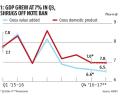
It is difficult to reconcile the GDP numbers with other economic indicators.

The survey, however, said that GDP is expected to revert to growth terrain next year, when it is likely to grow by 7.2 per cent.

The contraction in November this year is the second biggest fall in the current financial year.
Data released earlier by CAG shows capital expenditure by the Centre had contracted 9.2 per cent in Q2

Their implementation is expected to create investment owing to improving ease of doing business as well as initiating pro-worker measures.

'The actions of Indian monetary authorities will depend on how quickly they want the inflation to come down to 4 per cent.'

7 states account for over 80 per cent of the total direct tax collections by the Union government.

Happily, it does not require the world to hold a mirror up for us. We can look at ourselves and understand easily if we choose to be honest about where we find ourselves three quarters of a century after Independence, asserts Aakar Patel.

For example, railways, roads and highways, and shipping could form a section within the Budget as an omnibus transport sector

Chief economist at State Bank of India has revised downward the full-year growth forecast to a low 6.8 per cent from 7.5 per cent earlier for FY2023, citing "the way below GDP numbers for the first quarter". The National Statistical Office on Wednesday released the Q1 growth numbers which showed a consensus growth of 13.5 per cent, pulled down by the poor show of the manufacturing sector, which reported a paltry 4.8 per cent expansion in the first three months of FY23, negating the robust show by the services sector. Consensus forecast was 15-16.7 per cent of which the RBI made the highest forecast of 16.7 per cent.
Aim of the project is to boost manufacturing on a sustainable basis and through it, overall economic growth.
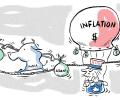
'The biggest risk to the Indian markets from a 12-18-month view is that the current government does not get re-elected, or loses in a way that is not represented at all in the next central government.'

The IOA ad-hoc committee on Wednesday decided to hold much-awaited Asian Games wrestling trials on July 22-23.

Stepped up public expenditure must be accompanied by focused policies, advises Vinayak Chatterjee.

After navigating the turbulent pandemic waves, the recovering Indian economy is now sailing through unchartered waters of rising coronavirus cases, spiralling commodity prices and spiking inflation though the lighthouse of sustainable growth remains visible. As 2022 begins, a raft of developments, ranging from Budgetary announcements to continuation of stimulus measures to monetary policy, will set the tone for the domestic economy, which is projected to grow more than 9 per cent in the current fiscal ending March 2022. The country's continuing massive vaccination drive and 'precaution' doses starting for select categories of people this month will provide a firewall against any steep spike in coronavirus cases amid the emergence of the Omicron variant.
New data is puzzling as these aren't corroborated by other data

The senior Congress leader also said over 90 per cent of jobs are in the SME sector which requires an urgent push to boost the economy.

'Let us hope that this Budget delivers.' 'It needs 10 per cent plus real GDP growth in 2021-22, the rebound year,' notes Omkar Goswami.
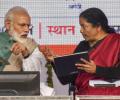
In the 2020-21 Budget, the prime minister and the finance minister are keen to stamp their narrative, after various rollbacks following the previous Budget, said top government sources. Besides the scheduled meetings, the sources said, the Prime Minister's Office is expected to hold several meetings with top secretaries and officials on various ongoing schemes, their performance and also how some of them could be tweaked for better results.

The RBI on Friday said the impact of coronavirus outbreak on the economy will depend on the intensity, spread and duration of the deadly virus even as the central bank refrained from projecting any numbers for growth and inflation amid the widespread uncertainty. While announcing the seventh bi-monthly monetary policy statement for 2019-20, RBI Governor Shaktikanta Das said that in view of the impact of coronavirus pandemic, the growth projections for 4.7 per cent for the fourth quarter of 2019-20 and 5 per cent for the full fiscal are "now at risk".
During the six-month period (April-September 2019), the Indian economy grew 4.8 per cent as against 7.5 per cent in the same period a year ago.
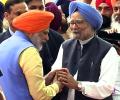
Whether it was the MGNREGS or the NFSA or the Aadhaar-based DBT scheme for cash transfer, the Modi government has built on the basic architecture created by the Singh government. Policy makers in the Modi government, instead of discarding them as products of the previous political regime, worked on them, expanded their scope and reach, and used new tools to improve their performance, explains A K Bhattacharya.

In fact, India's investment activity growth is also estimated to touch a 17-year low in FY20. With overall demand not showing signs of revival, investment activity may take longer to recover, economists said.

The previous high in quarterly GDP growth was recorded in the January-March quarter of 2015-16 at 9.3 per cent.

Economic performance is affected if large numbers of people are out of work, or at such low levels of income as to force under-consumption, observes T N Ninan.
